
WE BUILD THE ROAD THAT YOUR BUSINESS WILL TRAVEL ON
All the way to value
Home > All the way to value
Our Concept: All the Way to Value
The All the Way to Value concept is based on identifying where Epical can support customers' challenges in enterprise asset management within the building blocks of process, support systems, organization, and digitalization solutions. Sometimes the solution may lie in individual building blocks, but often several building blocks need to be combined to create the foundation for reaching all the way to value.
Epical will act as an advisor and offer the right combination of solutions that will create the highest value based on the customer's challenge. The goal is to create synergy between the company's processes, support systems, organisation and digital solutions. The more these building blocks are connected, the greater the value that will be created.
What Losses Are You Suffering and How Can We Take You All the Way to Value?
For You Who Are a Site Manager
The challenge when facing problems often lies in understanding which part of the organization owns the root cause of the problem, as losses and waste are often caused by each other.
What are your biggest losses?
Our services are packaged to take you all the way to value regardless of loss.
For Those Who Work in Production
One of the biggest challenges is often that one loss generates several new ones. For example, low operational reliability generates high inventory levels, which in turn generate long lead times and costs to avoid poor delivery precision.
Another example could be that long changeover times lead to running large batch sizes, which in turn can cause high levels of WIP (Work in Progress) when you have to break down the batch to make way for another, much more important one. This can also result in significant quality issues when things go wrong. If there is a significant difference in what is processed for each item produced, there is also a high risk of overloading the system from time to time, which often leads to new errors.
So it's easy to fall into a vicious cycle with a lot of losses and waste that characterize everyday life. However, it becomes a virtuous cycle if you eliminate or reduce the losses and waste that cause new ones.
What are your biggest losses?
Our services are packaged to take you all the way to value regardless of loss.
For Those Who Work with Maintenance
One of the biggest challenges can be that your organization finds it more enjoyable to fix errors urgently rather than prevent them and run a more planned operation. If this focus is not changed, it means that although errors are likely fixed quickly due to frequent practice, the production process is characterized by many stops, which in turn creates system losses when the equipment interferes with each other. If long breakdowns also characterize everyday life, production and logistics become difficult to plan.
Production compensates for this with inventory, more personnel, extra shifts, or parallel equipment that might not have been needed if operational reliability was in place to ensure delivery precision. However, the maintenance cost can be lower in such a reactive operation than if the "maintenance debt" did not exist. On the other hand, the indirect maintenance costs and lost production related to poor operational reliability are often significantly higher.
Thus, operational reliability work requires high discipline, where most investments in money and commitment are about being able to foresee problems before they become a reality. This work starts already in the acquisition process and continues throughout the entire lifespan of the equipment until it is disposed of.
What are your biggest losses?
Our services are packaged to take you all the way to value regardless of loss.
For Those Who Work with Inventory
The warehouse handles large inventory values that must be accurate from an authority perspective, and the inventory value must be constantly optimised to reflect the need for delivery reliability for all items. Excessive inventory costs will have a direct impact on the profitability of the business. Similarly, poor delivery reliability for warehouse items can lead to poor delivery precision in production. In such cases, production compensates with stock, more staff, extra shifts or parallel equipment that might not have been necessary if delivery reliability for warehouse items had been in place to ensure delivery precision. What are your biggest losses? Our services are packaged to take you all the way to value, regardless of loss.
For you who Work with Purchasing
Purchasing handles both large and small purchases, and it is important to buy the item from a supplier who can deliver the right quantity with the right quality at the right price. You want to find suppliers who themselves have a supply chain with minimal waste and losses, who can maintain high delivery precision and quality at an attractive price. Therefore, follow-up, order, and control of your suppliers are just as important as ensuring delivery monitoring of each purchase.
A poorly managed purchasing process can create indirect losses in maintenance inventory and production, and lead to the business making incorrect investments or paying too much for what is procured.
Purchasing plays a very central role in the acquisition process where the right choice of equipment and supplier can be crucial for the productivity that the acquired equipment can achieve during its lifespan and how it will, in turn, affect the value flow where the equipment will be included.
What are your biggest losses?
Our services are packaged to take you all the way to value regardless of loss.
For you as a Site Manager responsible for the overall enterprise asset management work in the organization, the goal and focus are generally on delivering the right number of items with the right quality at the right time and at a low cost. There is also a responsibility to ensure that the operation has high personnel safety, meets occupational health and safety requirements, and has the lowest possible environmental impact. Many of the key performance indicators that are monitored are summaries that reflect the sum of the ownership delegated down in your organization.
The challenge when facing problems often lies in understanding which part of the organization owns the root cause of the problem, as losses and waste are often caused by each other.
What are your biggest losses?
Our services are packaged to take you all the way to value regardless of loss.
For you as a Production Manager responsible for operations and production in the business, the goal and focus are generally on delivering the right number of items with the right quality at the right time and at the lowest possible production and inventory cost. There is also a responsibility to ensure that the business has high personnel safety and the lowest possible environmental impact.
One of the biggest challenges is often that one loss generates several new ones. For example, low operational reliability generates high inventory levels, which in turn generate long lead times and costs to avoid poor delivery precision.
Another example could be that long changeover times lead to running large batch sizes, which in turn can cause high levels of WIP (Work in Progress) when you have to break down the batch to make way for another, much more important one. This can also result in significant quality issues when things go wrong. If there is a significant difference in what is processed for each item produced, there is also a high risk of overloading the system from time to time, which often leads to new errors.
So it's easy to fall into a vicious cycle with a lot of losses and waste that characterize everyday life. However, it becomes a virtuous cycle if you eliminate or reduce the losses and waste that cause new ones.
What are your biggest losses?
Our services are packaged to take you all the way to value regardless of loss.
For you as a Maintenance Manager responsible for operational reliability in the business, the goal and focus are generally on creating reliable operations and production with high personal safety at the most accurate maintenance cost possible.
One of the biggest challenges can be that your organization finds it more enjoyable to fix errors urgently rather than prevent them and run a more planned operation. If this focus is not changed, it means that although errors are likely fixed quickly due to frequent practice, the production process is characterized by many stops, which in turn creates system losses when the equipment interferes with each other. If long breakdowns also characterize everyday life, production and logistics become difficult to plan.
Production compensates for this with inventory, more personnel, extra shifts, or parallel equipment that might not have been needed if operational reliability was in place to ensure delivery precision. However, the maintenance cost can be lower in such a reactive operation than if the "maintenance debt" did not exist. On the other hand, the indirect maintenance costs and lost production related to poor operational reliability are often significantly higher.
Thus, operational reliability work requires high discipline, where most investments in money and commitment are about being able to foresee problems before they become a reality. This work starts already in the acquisition process and continues throughout the entire lifespan of the equipment until it is disposed of.
What are your biggest losses?
Our services are packaged to take you all the way to value regardless of loss.
For you as a Warehouse Manager responsible for inventory management in the business, the goal and focus are generally on ensuring the availability of all inventory items at the lowest possible storage cost.
The warehouse handles large inventory values that must be accurate from a regulatory perspective, and the inventory value needs to be continuously optimized to reflect the need for delivery reliability of all items. High storage costs will have a direct impact on the profitability of the business. Similarly, poor delivery reliability of inventory items can lead to poor delivery precision in production. In such cases, production compensates with inventory, more personnel, extra shifts, or parallel equipment that might not have been needed if the delivery reliability of inventory items was in place to ensure delivery precision.
What are your biggest losses?
Our services are packaged to take you all the way to value regardless of loss.
For you as a Purchasing Manager responsible for operational and more strategic purchasing in the business, the goal and focus are generally on ensuring that purchases are made cost-effectively and handled correctly.
Purchasing handles both large and small purchases, and it is important to buy the item from a supplier who can deliver the right quantity with the right quality at the right price. You want to find suppliers who themselves have a supply chain with minimal waste and losses, who can maintain high delivery precision and quality at an attractive price. Therefore, follow-up, order, and control of your suppliers are just as important as ensuring delivery monitoring of each purchase.
A poorly managed purchasing process can create indirect losses in maintenance inventory and production, and lead to the business making incorrect investments or paying too much for what is procured.
Purchasing plays a very central role in the acquisition process where the right choice of equipment and supplier can be crucial for the productivity that the acquired equipment can achieve during its lifespan and how it will, in turn, affect the value flow where the equipment will be included.
What are your biggest losses?
Our services are packaged to take you all the way to value regardless of loss.
How Can We Help You All the Way to Value?
We help you develop Enterprise Asset Management based on processes, organization, support systems, and digital solutions to achieve full value.


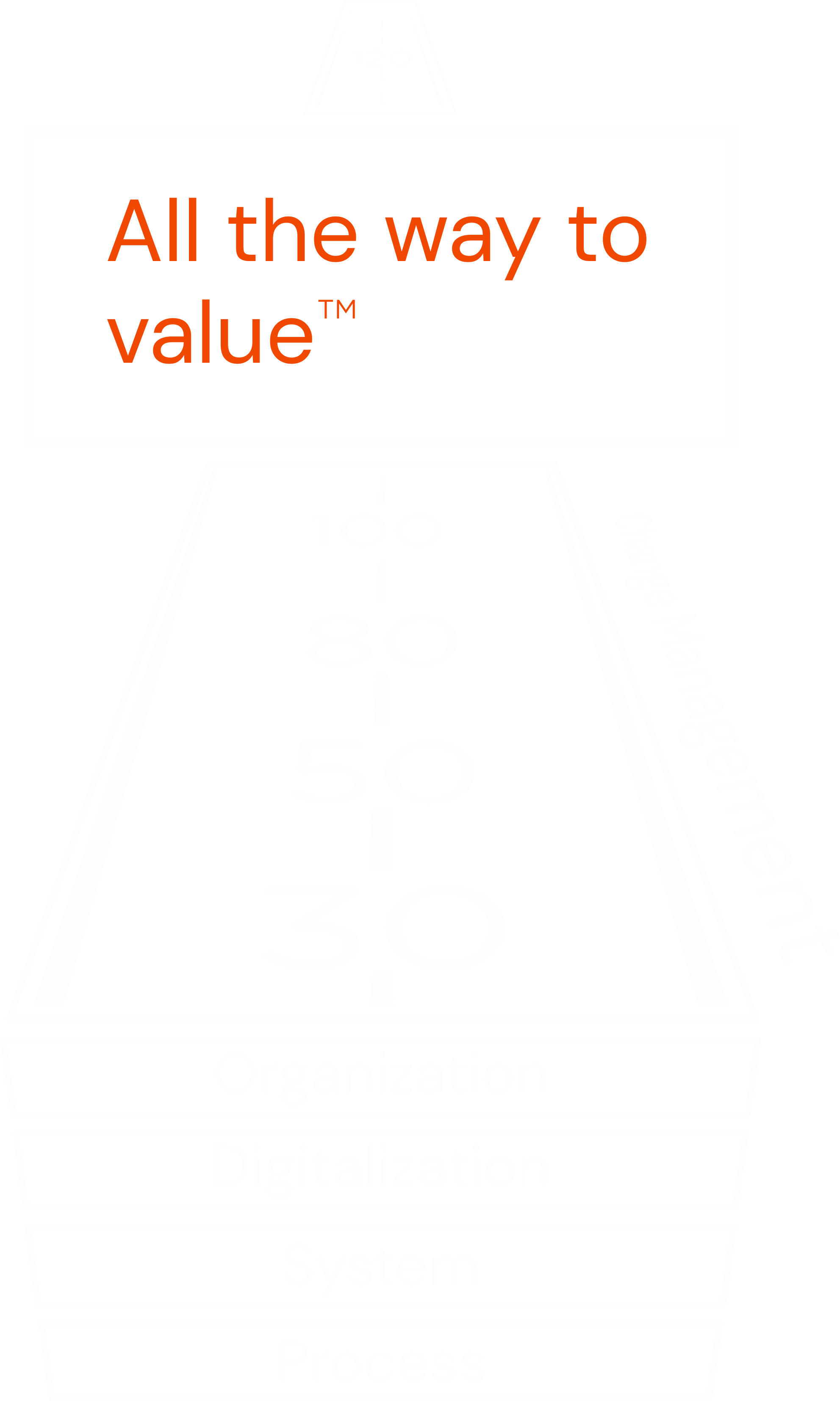

We are continuously developing our best practice approach in standardization, system configuration, training, and technical solutions, and are always on the lookout for smarter support systems and digital solutions that can create even more efficient processes.
Process
Our process-related offerings are designed to identify potential areas for improvement, map and standardize processes to eliminate variation, introduce structure and alignment in how the organization operates, and ensure data quality.
To improve operations/production, we offer the implementation of recognized improvement methodologies to eliminate waste and losses, and to enhance lead times, performance, and costs.
Support systems
Our support system offerings are designed to support asset management processes and enable organisations to run their processes efficiently. IBM Maximo and Efecto are available as asset management solutions, and we offer licence sales, consulting, upgrade implementation, development, training, resource reinforcement and support.
Visuella Fabriken’s 4,000 visualization products are designed to support safety and continuous improvement efforts. We also offer partner-driven solutions such as downtime tracking systems, inventory solutions, Andon, activity management, and simulation.
Organization
Our ambition is to be able to provide training in everything we implement and develop. Today, we offer around 50 courses at varying levels – from introductory and in-depth training to role-based courses and e-learning, all within the field of asset management.
We also offer consulting services where we work within the customer’s processes – everything from interim management solutions, engineering services, improvement leaders, and project managers to conducting root cause analyses. Change management focuses on identifying and resolving organizational challenges.
Digitalization
As Epical is an IT company with extensive expertise and over 400 specialists in digitalization, we also provide digital solutions.
The solutions are found within data collection, data storage, and integration to ensure the right information is available at the right time, in the right place, and at the right cost. This also includes AI solutions, data security such as identification and data access, decision support solutions that support asset management processes, and IoT solutions to become even more data-driven within asset management.
Development Journey
As our ambition is to create value for our customers, we strive to understand their challenges and issues to determine whether our solution lies in processes, support systems, organization, or digitalization. Often, the right solution is clear, and we address that specific problem, but many times there are multiple solutions to one problem. However, we will always recommend the most appropriate offering to create the greatest value for the customer. If the challenge is related to developing a business, we package our offerings as a development journey.
Example
- We develop the identified working methods based on our best practice library and your existing methodology.
- We implement/configure the system support to fully support the process.
- We identify and develop digital solutions to create efficient and user-friendly workflows.
- We provide training in developed standardization and operation of support systems and any digital solutions.
- We develop solutions for tracking and confirming process behavior.
- Ongoing support for the development of processes, support systems, organization, and digitalization based on confirmation and tracking.

Frequently asked questions
There are also clients who, as part of a multi-year development process, conduct annual audits of their various operations in order to measure their progress towards their desired state.
In cases where we do not have a clear picture of what the process should look like, we map out the process.
Starting from something that has already been designed to work optimally is much quicker than if we were to start from scratch.
Epical uses process mapping when the aim is to standardise the process and Epical does not have a clear picture of how the process should be designed.
Epical uses value stream mapping when the aim is to conduct a subsequent value stream analysis to identify which wastes and losses need to be reduced or eliminated in order for the value stream to deliver in line with set targets. The value stream map also shows the countermeasures for visualisation and how the value stream is intended to look once the targets have been met.
Following an analysis of the value stream data, one generally has a clear picture of where in the value stream action should be taken to achieve objectives, and what knowledge of tools and methods the organisation needs to put theory into practice.
The lean journey is now underway, and going forward it is important to continue focusing on value streams and to instil a new culture within the organisation that strives to eliminate waste and losses, rather than learning to live with them.
We see the next step as reaching the next level in the pursuit of sky-high productivity in harmony with sustainability by utilising the wealth of available data, now that we are seeing the EAM system (Maintenance System) – the Maximo Application Suite – take shape, designed to provide system support for this very purpose. For over 10 years, this vision has been presented as the 4th industrial revolution: ‘Digitalisation’. But it is only now, in 2025, that we see the conditions in place to be able to put this into practice in full.
It is important to bear in mind, however, that all these philosophies, methods and technical tools are interdependent; it is not a question of choosing one path over another, but rather that everything is interconnected.
TPM and other similar maintenance strategies focus on ensuring operational reliability and high machine availability by being designed to eliminate waste. Many of the key Lean principles in the pursuit of eliminating waste depend on operational reliability to function effectively and avoid disaster, particularly where the value stream involves a manufacturing process. The sustainability approach is based on LEAN philosophies with a reinforced focus on sustainability. In all these principles, standardising operations is a key fundamental principle. Standardised processes, for example, are a prerequisite for data quality, which in turn is a prerequisite for becoming even more data-driven and reaching the next level of productivity in symbiosis with sustainability.
Yes, the most common image used to illustrate efficiency to perfection is the classic scene of a Formula 1 ‘pit stop’. Here, order and organisation have been taken to the extreme, with a singular focus on time efficiency. So, naturally, order and organisation are often a fundamental prerequisite for efficient processes. However, order and organisation using the 5S method need not be limited to workshop areas; it can, for example, be applied in administrative and IT systems as well.
Our view on education is that each area of expertise may require a different level of depth, which will influence the structure and delivery of the courses:
- Insight & understanding – Short theoretical training session (<4 hours)
- Knowledge – Theory combined with practical exercises, both individually and in groups
- Skills – Theory combined with practical exercises, undertaken both independently and in groups, supplemented by an assignment in the subject area to be practised after the course has ended, which is then reviewed during a follow-up session.
This approach is underpinned by standardised processes, configured systems, integrated digital solutions, and clearly defined roles, responsibilities and authorities within the organisation.
In order to translate this approach from theory into practical application in the day-to-day work of everyone in the organisation, various change management principles must be applied. The focus here is on ensuring that everyone feels included and informed, understands the purpose and objectives, and is given the means to successfully develop the necessary skills.